Indigo Design System
From operational chaos to structured clarity: designing a unified system for Africa's growing property management market
Role
Strategy, Planning, Visual & Product Design, Prototyping
Team
Bolu Obisanya, Product Designer (sole designer), working directly with Indigo's CEO and Full Stack developers
Year
2025
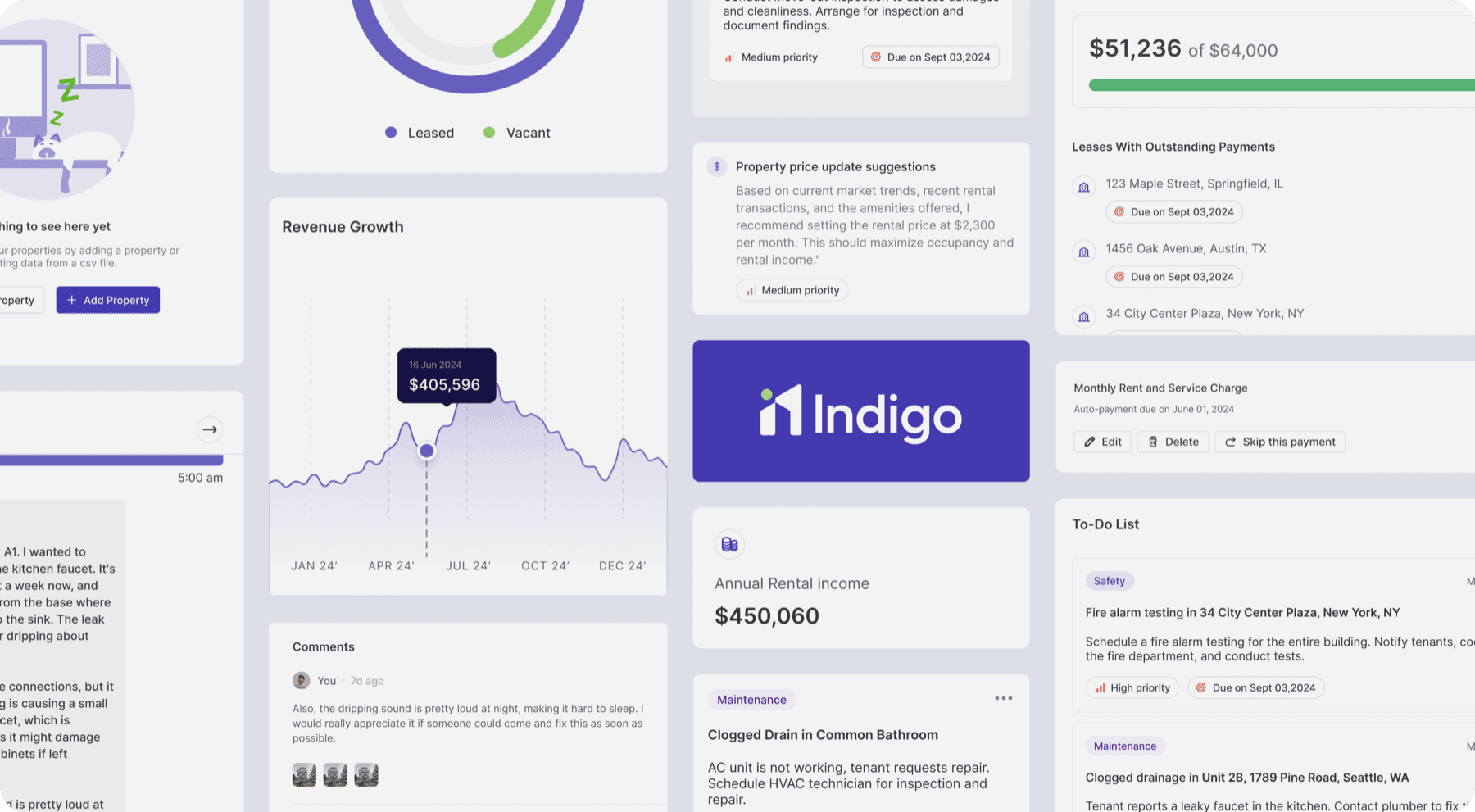
Building the Foundation for a Scalable Property Management Experience
Indigo is a property management platform built for landlords, agents, and tenants across Africa. As part of the founding team, I was responsible for designing a unified, scalable design system that supports Indigo's features while laying the foundation for long-term growth.
We aimed to simplify fragmented processes — from onboarding tenants to tracking payments and managing repairs — all within a single dashboard tailored to different user roles.
An Opportunity to Standardize Fragmented Workflows
Property managers and landlords often rely on spreadsheets, messaging apps, and manual reminders to handle tenants, payments, and maintenance issues. This results in missed deadlines, lost records, and poor tenant experiences.
We needed a modular design system that could:
- Support role-based views (e.g., Tenant vs. Landlord)
- Scale with features like ticketing, payments, and unit onboarding
- Reduce visual noise while preserving functionality for power users
Research Insight: Taking Stock of Issues Through Familiar Frameworks
Indigo's CEO — a property manager himself — led direct research with landlords and tenants before I joined the design process in earnest, mapping out real-world onboarding flows, rent collection pain points, maintenance reporting gaps, and communication breakdowns between stakeholders. I worked from those findings rather than conducting the interviews myself; the original research documentation from that phase is no longer available to reference directly, but the insights shaped every downstream decision.
I then worked closely with the CEO and our Full Stack developers to translate those findings into information architecture, user roles, and MVP scope — treating the CEO's domain experience and the research he'd already gathered as the foundation, and stress-testing it against what was technically feasible to build.
Aligning Product Architecture with Real-World Roles
We designed Indigo around three primary user types — each with its own visual priorities, permissions, and workflows:
- 1
Landlords/Agents — Manage properties, track income, approve tickets
- 2
Tenants — View leases, make payments, report issues
- 3
Admins — Monitor platform activity and resolve escalations
Building a System to Drive Consistency and Scale
With limited engineering bandwidth, our design system had to be practical — not theoretical. I focused on clarity, reusability, and visual hierarchy across components.
Design Principles
- 1
Contextual Clarity — Every element serves the user's immediate goal
- 2
Scalable Consistency — Components adapt across device sizes and user roles
- 3
Performance Minded — Optimized for 3G networks prevalent in target markets
- 4
Accessibility First — Designed with WCAG 2.1 AA as a target throughout
Foundations
- 1
Typography — Clean sans-serif system for high readability
- 2
Spacing & Grid — 8pt grid system for visual consistency
- 3
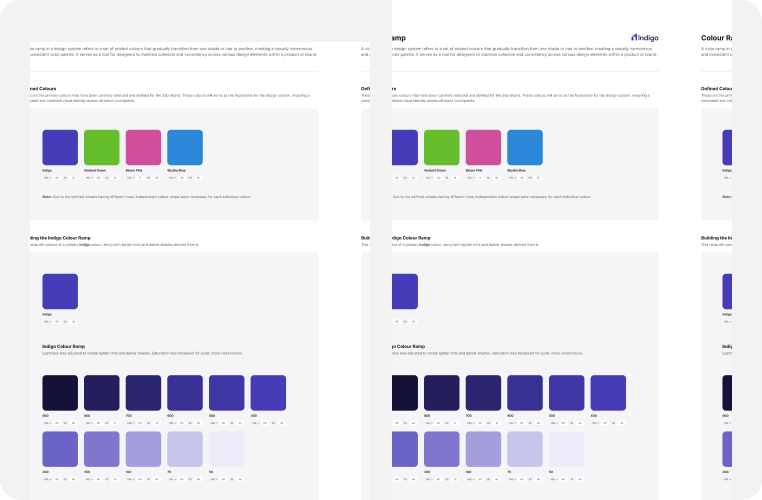
Color — Primary, secondary, tertiary, quaternary, accent, neutral
(Color ramp snapshot — sample data shown for illustration)
Components
- Action buttons, badges, status indicators
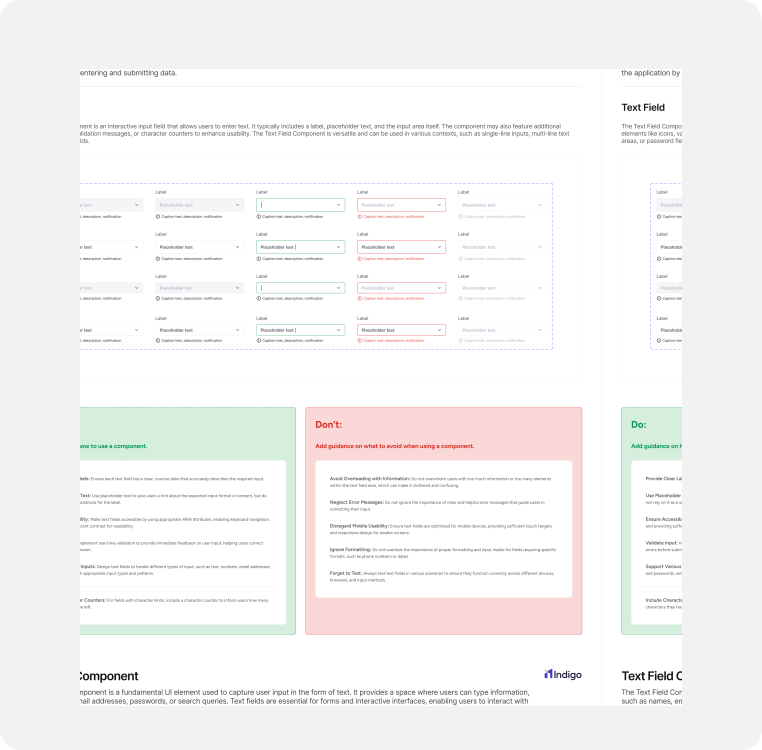
- Text fields, forms for KYC, rent, and issue reporting
- Tab systems and modals for multistep actions
(Text field component snapshot)
Working from a CEO who already understood the day-to-day realities of property management meant the design-system phase itself was a fairly low-friction build — most of the hard tradeoffs had already surfaced during his earlier research, which let the system design focus on structure and reuse rather than resolving open debates about what the product should do.
Where Things Stand
Indigo is still in active development, and the design system continues to evolve alongside the product. As we move toward launch, the priority is making sure the system holds up under real usage — not just internal review.
What we'd measure once live:
- Whether the role-based component structure actually speeds up feature development, versus a flat, one-size-fits-all UI
- Support ticket volume tied to onboarding and payment flows specifically, since those were the sharpest pain points identified in the CEO's original research
- Component reuse rate across new features, as a signal of whether the system is actually reducing duplicated work rather than just looking organized
What's next:
- Smart financial insights for landlords
- AI-driven rent and occupancy forecasts
- Multi-channel messaging components for tenant engagement
(Dashboard and financial figures shown throughout this case study are illustrative sample data used during the design process, not live platform metrics.)